

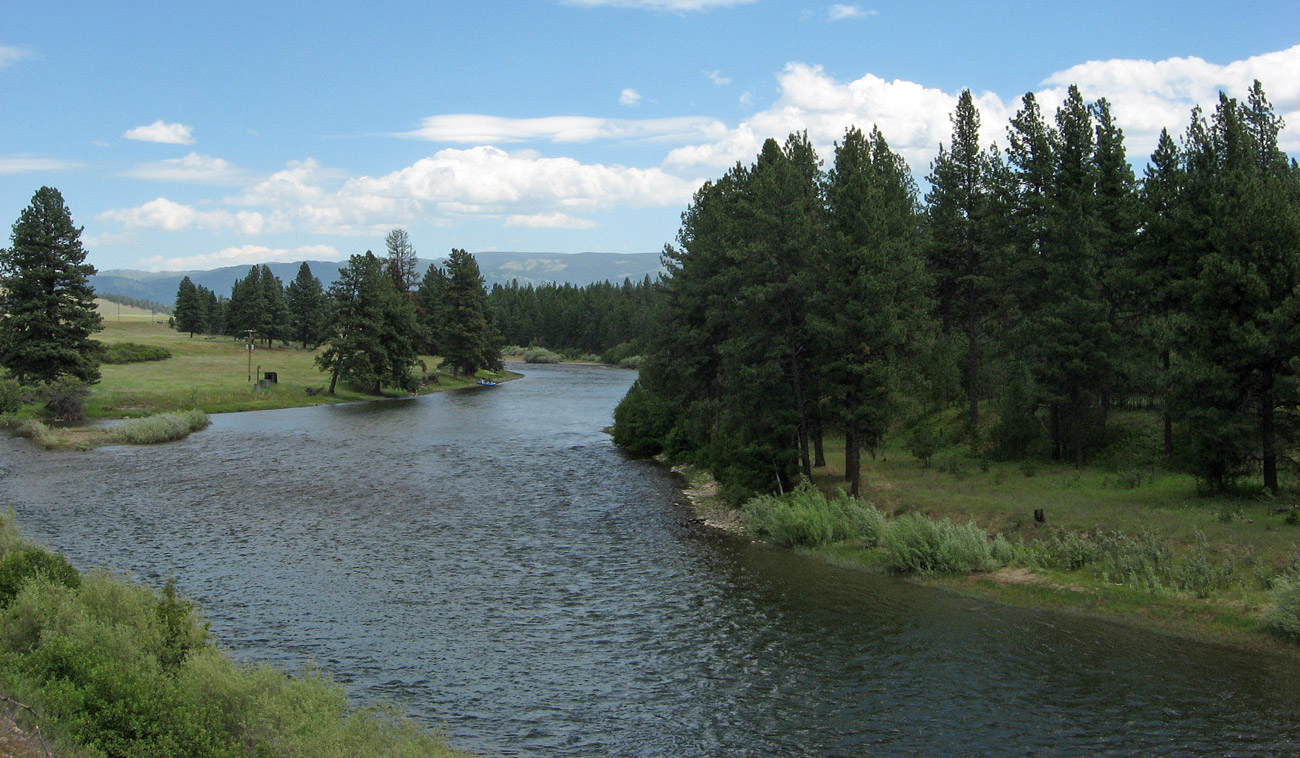
The Blackfoot River is one of the finest rivers in Montana. Exceptional scenery, classic trout water habitat and a wide variety in the river all combine to make a fly fishing or recreational floating trip on the Blackfoot River a memorable one.
Table of Contents
- Blackfoot River – Introduction & Overview
- Fishing the Blackfoot River – Overview
- Fly Fishing the Blackfoot River – Detailed Info by River Segment
- Floating & Paddling the Blackfoot River
Related Article – Blackfoot River Photographs
Blackfoot River – Introduction & Overview
Prior to the 1992 release of the movie A River Runs Through It, the Blackfoot River was not well known by out-state anglers. Today, the Blackfoot is one of the more popular rivers in Montana. Visitors and locals all utilize the river for fly fishing, rafting and just relaxing along a scenic river not far from Missoula.
Anyone floating down the Blackfoot River will find whitewater enthusiasts running the numerous rapids, many wade fisherman, and in the lower stretches of the river, people floating down the river on inner-tubes and other “various things” that just happen to float. The rivers close proximity to Missoula, which is the fastest growing region of the state, also keeps river use high.
While the Blackfoot River is indeed popular and receives heavy use, actual fly fishing pressure is not as heavy as some other notable Montana rivers. Much of the use on the Blackfoot is for non-fishing uses. As a result, the fishing is excellent, helped in large part by the management by the Montana Fish, Wildlife and Parks (FWP).
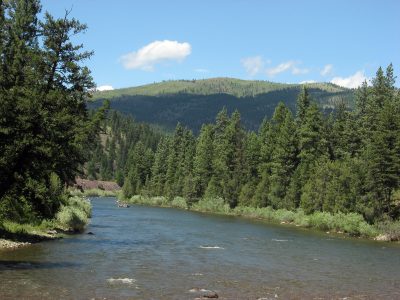
Blackfoot River in the Blackfoot River Corridor. The Blackfoot River is popular with float parties, especially on summer weekends when the weather is nice.
The Blackfoot River, for more than 30 miles on the lower stretch of the river, flows through the “Blackfoot River Recreation Corridor.” This corridor is a cooperative land agreement between FWP and the private landowners along the river, which has allowed for excellent access to the river while reducing the impact from its heavy use.
The Blackfoot River begins along the continental divide in the mountains outside Lincoln, and flows through scenic and diverse countryside for 130 miles before its confluence with the Clark Fork near the town of Bonner.
In the upper half, the river runs slowly through dense forests with brushy and timbered banks. Numerous logjams are found in the river. Access is excellent above Lincoln, as much of the river flows through National Forest land. Below Lincoln, several fishing access sites exist, in addition good road access is found just off of Highway 200 for much of this stretch.
Beginning near River Junction Fishing Access Site, about the halfway point on the river, the river picks up velocity and continues with quick to moderate flows all the way down to the Clark Fork. For the first twelve miles, the river flows through a broad, sparsely wooded plain. A wildlife preserve exists on the far side of the road to the north of the river. This section of the river is an excellent spot to observe wildlife. Elk, moose, deer and bears are all be found along this section.
The river then flows through a beautiful canyon, which has some whitewater at the tail end of it, and then soon joins the Clearwater River at Clearwater Junction.
Beneath Clearwater Junction, the Blackfoot enters the mountains and the protected river corridor. The pace of the river through this section is quick, with many moderate rapids and deep pools. Many designated campsites exist along this section of river. One thing to keep in mind is that camping is not allowed except at designated campsites in the Blackfoot River Recreation Corridor.
The river emerges from the mountains just a couple of miles above the Clark Fork. All use of the river ends a half-mile above Bonner, as a small dam blocks the way. Below the dam, the river flows for another mile and a half before the confluence with the Clark Fork.
Fishing the Blackfoot River – Overview
The Blackfoot River was one of the forgotten rivers by visiting anglers in Montana prior to the release of the popular movie of A River Runs Through It in 1992. Following the release of the movie and the placement of the Blackfoot River on the ten-most endangered rivers due to the potential threat of a large mine at the time (the mine never got full approval due to a state wide initiative that killed the practice of cyanide gold mining), the Blackfoot rose from obscurity to national prominence almost overnight.
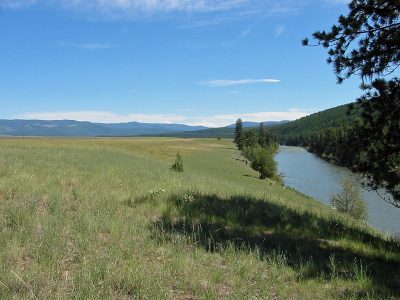
Blackfoot River near Corrick River Bend Fishing Access Site
Today, the Blackfoot River ranks not only as one of the prettiest rivers in this part of Montana but also one of the most heavily used. Excellent fly fishing, combined with its close proximity to Missoula that attract many recreational floaters, can turn the Blackfoot River into a very crowded place on a summer weekend.
While the Blackfoot River does see its share of use, a good portion of the use is on the weekends by either local fisherman or recreational floaters from the Missoula area. Arriving on the river during mid-week or before Memorial Day or after Labor Day usually finds the river relatively empty, providing for a more pleasant fishing environment—especially for the wade angler (who otherwise would need to do battle with all the “flotation devices” that make their way down the river on a summer weekend).
Of course, another reason the Blackfoot River is so popular is because it is both very scenic and diverse. Excellent fly fishing for brown trout and rainbow trout is found throughout most of its length in a very nice, relaxing setting.
The Blackfoot River has both very good access and is quite long (130 miles), helping to spread the use around and to keep the fly fishing pressure down to manageable levels. Any angler who has the time and plans on fly fishing either the nearby Rock Creek or Bitterroot River should plan to visit the Blackfoot River, as excellent fishing in a wonderful setting awaits.
Fly Fishing the Blackfoot River – Detailed Fishing Information by River Segment
Blackfoot River : Origin to Lincoln
This short stretch of the Blackfoot River, which runs for 22 miles, is the only section of river which has poor fishing. In this stretch, the river is very narrow and quite shallow. During cold, dry winters, parts of the river in this stretch can either dry out or freeze-up completely—events not conducive to good fishing. The handfuls of fish that struggle to survive in this harsh environment mainly include some small cutthroat and brown trout that are found in the vicinity of Lincoln. Basically, on this stretch, the closer you get to the origin, the worse the fishing becomes.
Blackfoot River : Lincoln to Mineral Hill Fishing Access Site
The Blackfoot River flows for twenty-five miles in this section through some very scenic countryside. Downstream from Lincoln the river threads its way through some small, forested mountains. It twists and turns extensively in this section. Access is also very good. Highway 141 closely follows the Blackfoot River, allowing easy road access. Despite the easy access, this part of the river has relatively low fishing and recreational floating pressure.
The low pressure on the river here stems from its distant location from Missoula, its difficult floating conditions and because the quality of the fly fishing, while good, is not as good as found further downstream.
Fly fishing on this stretch of the Blackfoot River is a challenge. Brown trout make up most of the fish in this section. While the numbers of brown trout are only average, their size is often well above average. Brown trout reaching twenty inches are found all along this section of the Blackfoot.
Like brown trout everywhere, though, they are not the easiest to catch. Streamers are the fly of choice when chasing these brown trout, throwing them around the many undercut banks, around the extensive downed timber and into the few holes that can be found.
This section of river is best wade fished. While this part of the river can be floated, many logjams and other obstructions await the floater. Additionally, during low water periods later in the summer, it is not uncommon to end up dragging larger rafts or drift boats over the gravel bottom of the river. Shallower drawing boats, such as small inflatable rafts or inflatable kayaks, work better for late season or low water float fishing.
Blackfoot River : Mineral Hill FAS to Cedar Meadows FAS
This stretch of the Blackfoot River looks quite close together on the map, but yet stretches for more than eighteen-miles. The river twists and turns so extensively that six air miles between the two fishing access sites end up being eighteen river miles.
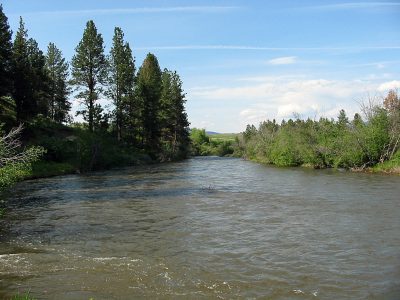
The Blackfoot River in Montana, seen here during spring run-off.
The current of the Blackfoot River is quite slow in this stretch. Large rafts or drift boats, unless you have all day or enjoy lots of rowing, are not suggested. Instead, a canoe, inflatable canoe or inflatable kayaks are the boats of choice on this stretch since they are much easier to paddle across long stretches of slow water.
The fly fishing on this stretch of river is not much different than found just above Mineral Hill. Brown trout dominate in these waters, and are found in the same locations as before: the holes, undercut banks and around downed timber. Streamers are once again the best flies to use on this section of the Blackfoot River.
Unfortunately, access is somewhat spotty, with only one fishing access site (Aunt Molly) found between Mineral Hill and Cedar Meadows. Since the Blackfoot River temporarily leaves the roads behind, no easy road access exists. Thus, floating this section of the Blackfoot River is the best way to cover as much water as possible.
Just remember to bring the proper boat along for a more enjoyable float. Similar to further upstream, later in the summer or during drought conditions this section of the Blackfoot River often has low water levels, leading to some portages and short drags over the river bottom. To avoid this, consider float fishing on this stretch between the end of spring run-off a (anywhere from late-May to mid-June) to the middle of July.
Blackfoot River : Cedar Meadows FAS to River Junction FAS
This section of the Blackfoot River runs for twelve-miles. The river straightens out significantly and the flow increases somewhat. While some stretches of slow water still exist, they are not nearly as extensive as found just upstream.
Once again, brown trout dominate this section of the Blackfoot River, although more rainbow trout appear just upstream from River Junction. Similar to fly fishing further upstream, streamer imitations fished in the holes, along the undercut banks and around downed timber and other natural cover provide the best fishing spots.
Access on this stretch of the Blackfoot River is also spotty. No designated fishing access sites between Cedar Meadows and River Junction, although one bridge crossing on Road 124 can provide access for the wade angler.
Blackfoot River: River Junction to Clearwater Crossing
Beginning at River Junction, refreshed as it is by the flows of the North Fork Blackfoot River and a steeper gradient, the Blackfoot River starts to have excellent rainbow trout fishing. The Blackfoot in this section flows through a wide variety of terrain. Initially it continues flowing along the southern end of the broad valley that it entered into at Mineral Hill FAS. This section in the valley lasts for twelve miles.
The river then enters Box Canyon, a five-mile long section of river with lots of riffles, pools, larger waves and one whitewater section near the end. Following its emergence from Box Canyon, the Blackfoot River travels through another small valley for a couple of miles before reaching Clearwater Crossing FAS.
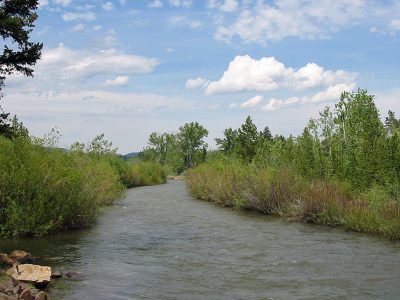
The Upper Blackfoot River is narrow, seen here during spring run-off.
For anglers willing to brave the fanciful weather of a Montana spring, fly fishing on this section of river can begin as early as the middle of March, assuming spring-run off hasn’t started yet (usually spring-run off begins on the Blackfoot anywhere between mid-April and mid-May and can last up until late May or early June).
During the spring, before spring-run off occurs, this section of the Blackfoot River (as well as the sections found further downstream), dry fly fishing with common flies such as the Parachute Adams, Sparkle Dun and Olive Cripple all work well, although good presentation is important. Popular nymph imitations for early season fishing on the Blackfoot River include the Hare’s Ear Nymph and the Pheasant Tail Nymph, all in sizes 16-20.
Following this short period of fishing, the Blackfoot generally turns turbid as spring-run off hits. However, during some years (warm springs or low snow years) spring-run off can happen early, leading to clear water by late May. When this happens, it is perfect timing since a salmon fly hatch occurs on the Blackfoot River in June. If you’re on the Blackfoot in late May through the middle of June with clear water, large salmon fly imitations such as the Bitch Creek Nymph and the Stimulator (sizes 2-8) all work well when fished on the bottom along the riverbanks, especially around deep holes, gravel banks and undercut banks.
Eventually, spring-run off will end. When it does, the Blackfoot River joins Rock Creek as one of the premiere summer dry fly fishing rivers in Montana. Common caddis imitations such as the Elk Hair Caddis and the X-Caddis all work well. Additionally, attractor dry flies such as the Olive Stimulator and a Green Renegade also work very well. Finally, common mayfly patterns such as the Adams also work on this section of the Blackfoot River. Dry flies can be fished successfully on the river all summer long, although the best success during the middle of the summer generally happens in the mornings and evenings when the water temperature is cooler.
When fly fishing dry flies during the summer, it is worth remembering that presentation is very important on this section of river—particularly between River Junction and Russell Gates FAS. The current in this section is fairly slow, giving the trout some time to look a bit more closely at the fly than is the case further downstream. Thus, a drag free float on light leaders often makes all the difference between success and failure when fishing dry flies. In Box Canyon, due to the riffles, waves and faster current, perfect presentation, while important (its always important!), is not as crucial as found just upstream.
If you grow tired of fly fishing dry flies or want to increase your chances of tagging into a large rainbow, then get rid of that dry fly and put on a grasshopper imitation. Like seemingly everywhere else in Montana, grasshopper imitations work very well from July to early September on the Blackfoot River. Grasshopper imitations are best fished right along the shore, essentially imitating a grasshopper that got stuck in the water. It also never hurts to put a few twitches into the hopper through light jerks on the line (this imitates a grasshopper struggling to break free). That said, if you see an appealing place further out in the water, don’t be bashful about hurling the hopper imitation out into the middle of the river. Large trout will readily come off the bottom of the river for a large meal like a hopper. Hopper imitations work best in sizes from 2-8.
Blackfoot River : Clearwater Crossing to Johnsrud Park
The character of the Blackfoot River changes markedly in this stretch. Gone is the wide open valleys and gently, twisting river slowly flowing through thick timber. Instead, it is replaced by a rock and boulder-strewn environment, with fast current and some whitewater. Numerous deep pools exist all along this section. The extensive riffles and whitewater also provide lots of pocket water fishing. Beautiful forests of ponderosa pine come down to the riverbanks.
This is the most popular section on the Blackfoot River, and is used extensively by both anglers and recreational floaters. So, especially on a summer weekend, be prepared to share the water with many other people.
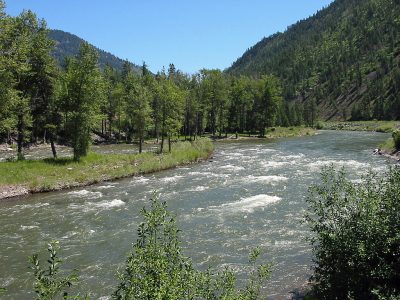
The Blackfoot River in Montana at Johnsrud Park Fishing Access Site
This section river flows through the Blackfoot River Recreation Corridor. Numerous designated fishing access sites exist on this stretch, and access is also possible off a good condition dirt road (Ninemile Prairie Road) that closely follows the river on the northern side. A number of special fishing and camping restrictions (camping allowed only in designated areas) exist, so be sure to check the latest fishing regulations before heading out.
Fly fishing from shore or wading is often a challenge on this stretch of river. Many slippery boulders await the unsuspecting wader, and the faster current guarantees an interesting ride for anyone who happens to lose their balance.
Float fishing can also be interesting on this stretch, as many large waves, boulders and some short whitewater sections (Class II) can provide for a fun float trip. It is also a very scenic float, as the Blackfoot River weaves its way through a mountainous, rocky and forested environment. Many beaches also provide a great place to stop and have lunch or to just sit back and enjoy the day.
The fly fishing in this section of the Blackfoot River is similar to what is found upstream between River Junction and Clearwater Crossing. The difference is that the faster current and roiling water allow for a more sloppy presentation. Thus, while fly fishing conditions might be more difficult in this stretch of the Blackfoot River due to faster current and rocky terrain, the trout are not quite as finicky as they are between River Junction and Russell Gates Fishing Access Site.
Similar to upstream, dry fly fishing and hopper fishing predominate during the summer on the Blackfoot River. Dry flies should be fished around the holes and in the extensive pocket water sections. An occasional undercut bank is also found. Colorful attractor patterns such as the Parachute Adams or Royal Wulff (in sizes 12-16) work particularly well in the riffles and pocket water sections. For the angler who enjoys fishing nymphs, the Hare’s Ear Nymph and the Pheasant Tail Nymph, sized 14-16, also work well and can catch the larger fish, especially when weighted and fished on a sink tip line in the deeper holes.
Blackfoot River : Johnsrud Park to Clark Fork
Beginning at Johnsrud Park, Montana Highway 200 rejoins the river, providing excellent if somewhat noisy access. Several other designated fishing access sites are also found along this stretch of the river. The Blackfoot River Recreation Corridor ends at Johnsrud Park, removing the special restrictions found just upstream.
This section of the Blackfoot has both very large rainbow and brown trout. The river has lots of riffles and many deep pools, along with countless boulders lying out in the middle of the river. When fly fishing this section, use the tactics described above, although the larger trout are usually caught using larger nymphs fished down deep in the holes.
Trout fishing on this section of the river ends two miles above the Clark Fork due to the presence of the Bonner Dam, which backs up the river for about a mile.
Floating & Paddling the Blackfoot River
The Blackfoot River is one of the best floats in Montana. Combining excellent and diverse scenery with a wide variety of river conditions, any float on the Blackfoot is a lot of fun.
Access to the river is excellent. The upper portion of the river frequently flows through public lands. The lower portion of the river flows through the Blackfoot River Recreation Corridor. This corridor provides numerous official access sites. Additionally, countless unofficial access sites are available off of Montana Highway 200 and several back roads that parallel the river on the other north side.
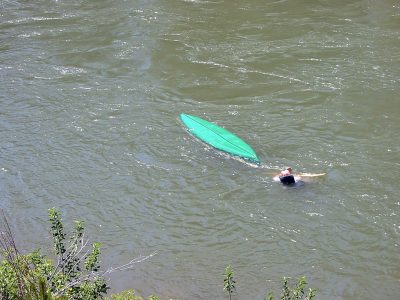
Capsized Canoe on the Blackfoot River in Montana, near Sheeps Flat Access Site
Floating and rafting can begin on the Blackfoot River near the town of Lincoln, more than 110 miles upstream from its confluence with the Clark Fork.
The upper portion of the Blackfoot is primarily slow water. The river is fairly narrow and flows through dense forests. Many logjams are found along the upper river, especially in the vicinity of Nevada Bridge, about 18 miles downstream from Lincoln. Wildlife is abundant on the Upper Blackfoot.
The Blackfoot River then flows into a big, broad plain. The first of the many rapids on the river is encountered several miles above Scotty Brown Bridge. This rapid is short and is easily navigable by rafters and floaters of intermediate skill.
Beginning at Scotty Brown Bridge, the river enters the Blackfoot River Recreation Corridor. For the first five miles, the river is marked by a quick flow, twisty turns, but no whitewater.
Beginning at Sperry Grade Access Site, which is five miles downstream from Scotty Brown Bridge, the whitewater section of the Blackfoot River begins. For the next seven miles, the Blackfoot River has numerous rapids, several of which are weaker Class III. Due to large waves and several small drops, this section of river should not be run in a canoe. Beginners in rafts should also be wary of running this stretch of the Blackfoot River as well.
Ideal boats for running this portion of the Blackfoot River are inflatable kayaks, quality recreational level inflatable rafts and the larger inflatable fishing rafts. Drift boats also work well, as do inflatable canoes if paddled by skilled paddlers.
Below this whitewater section, occasional Class II rapids are found intermittently down the remainder of the Blackfoot River, but should pose no problems to alert floaters. For those traveling by canoe, it is advisable to scout these rapids before running them, as the severity of the rapids changes greatly with fluctuating water levels.
The river finally slows down a few miles above Bonner Dam. A required portage, for those who wish to continue on down to the Clark Fork, is required a half mile above the dam.
Selected River Miles for the Blackfoot River
Listed below are selected river miles for the Blackfoot River in Montana. Visit the Montana FWP Website for specific information about a particular fishing access site (FAS).
- Origin: 132
- Highway 279 Bridge: 124
- Lincoln: 110
- Nevada Road Bridge: 92
- Mineral Hills: 85
- Aunt Molly FAS: 70
- Cedar Meadows FAS: 64.4
- River Junction FAS: 52.5
- Russell Gates FAS: 40.1
- Sunset Hill FAS: 31.4
- Roundup FAS: 29
- Ninemile Prairie FAS: 25.1
- Corricks River Bend FAS: 23
- Belmont Creek FAS: 21.2
- Red Rocks FAS: 19
- Thibodeau FAS: 17.7
- Sheep Flats FAS: 16.7
- Johnsrud Park FAS: 12.6
- K. Ross Toole FAS: 9
- Marco Flats FAS: 3.4
- Bonner Dam Takeout: 2
- Confluence with Clark Fork: 0
Related Articles on Big Sky Fishing.Com
- Blackfoot River Photographs
- Blackfoot River Corridor Scenic Drive
- Fishing & Floating the Clark Fork
- Missoula, Montana – Town info and photos