

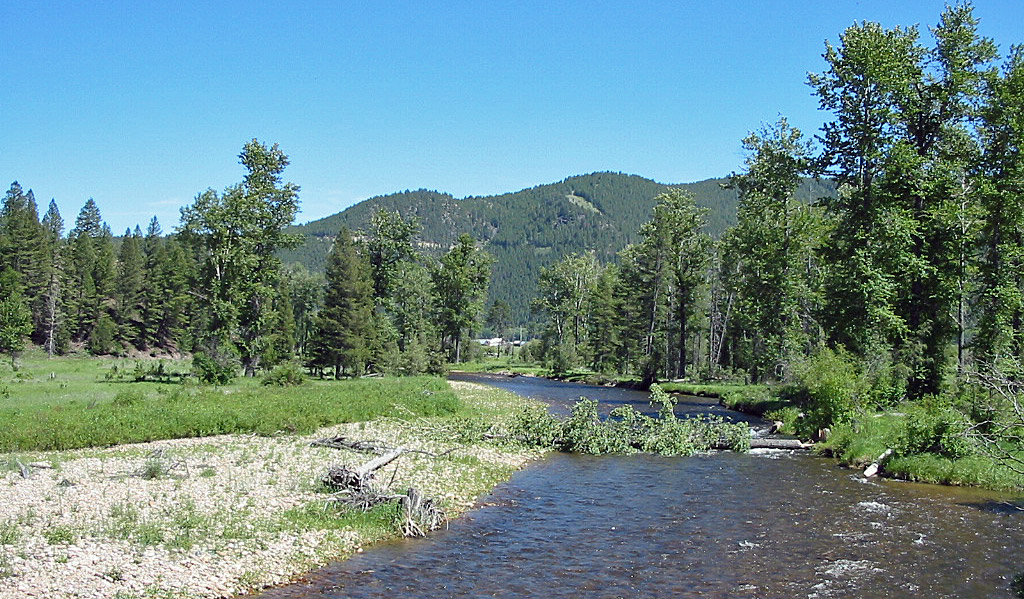
Rock Creek, located not far from Missoula, is one of Montana’s finest trout streams. And for wade anglers, a better river can’t be found. Rock Creek flows primarily through National Forest lands, allowing for excellent access for most of the rivers length.
Table of Contents:
- Rock Creek – Introduction
- Fishing Rock Creek from Origin to Highway 348 Bridge
- Fishing Rock Creek from Highway 348 to the Dalles
- Fishing Rock Creek form the Dalles to the Clark Fork
- Seasonal Hatches on Rock Creek
- Floating Rock Creek
Related article – Rock Creek Photographs
Rock Creek – Overview & Introduction
Formed by the confluence of the West and East Forks Rock Creek near Philipsburg in the Philipsburg Valley, Rock Creek flows between the Sapphire Mountains on the west and the John Long Mountains to the east.
Shortly after the confluence of the two forks, Rock Creek enters National Forest Land, and travels through it for the next thirty miles. A windy, bumpy, narrow road—the Rock Creek Road—follows the river for its entire length. After leaving National Forest Land, the river flows for a few more miles before emptying into the Clark Fork at Clinton.
As it flows through public lands for a significant part of it journey, access is excellent. Because of the excellent access to more than thirty miles of river, Rock Creek is a superb choice for anglers who plan to wade fish.
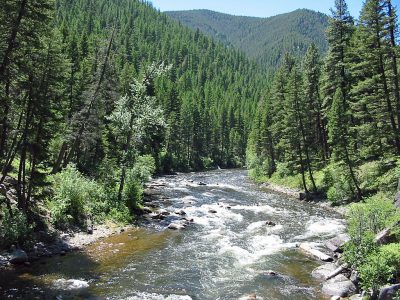
Rock Creek near the Dalles. The Dalles area is where the bulk of the whitewater is found.
Wade anglers will also enjoy the river’s relatively narrow width. Except in areas with rapids, deep pools or periods of high water, it is relatively easy to find spots to wade across the river—thus allowing anglers to reach prime fishing spots.
Moreover, restrictions limit the ability to fish while floating. Consequently, Rock Creek is not over-run by guided fly fishing parties. Combining that with the excellent access to the river, all a wade angler has to do is to pull off the side of the road and head for the stream.
Rock Creek itself has “trout water” written all over it. Rock Creek has swift flows, a fairly long whitewater section, extensive riffles, rock gardens and some beautiful deep pools. The river provides excellent fly fishing for rainbow trout, cutthroat and brown trout in an unspoiled location.
Use of the river ranges from light to heavy, depending on time of year and what part of the river you plan to fish. Rock Creek is well known as one of finest trout streams in Montana and use skyrockets during the prime hatches.
However, the lack of floating parties, combined with the ability to access Rock Creek along the forest road for more than 30 miles, spreads anglers around. For the fly fisherman willing to wander away from obvious access spots (particularly in places where the road is well back from the river), an angler can fly fish in relative solitude.
Several designated campsites and numerous unofficial campsites are found all along Rock Creek. And for those who don’t mind a bit of a drive, the town of Clinton offers lodging—while Missoula is just thirty miles or so down the road.
Rock Creek has a number of distinct sections throughout its length. For ease of use, each of the three sections are listed separately below, going downstream from its origin to Rock Creeks confluence with the Clark Fork fifty miles later.
Fishing Rock Creek: Origin to Highway 348 Bridge
This section encompasses nine miles of water, and flows through the southern end of the broad Phillipsburg Valley. Of the three sections on Rock Creek, this section has the least fishing pressure. To reach this section requires either a long and rather bumpy ride up Rock Creek Road, a twisty one-lane gravel road, or a round about trip through Phillipsburg. This section also has the most difficult access, since the river primarily flows through private property.
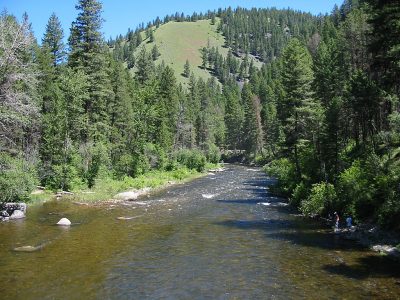
Upper Rock Creek is relatively narrow and has very clear water.
The upper section has smaller fish than the rest of the river. Rainbows and cutthroats make up the bulk of the fish, averaging around eight to twelve inches in length. However, some large rainbows, and even a few browns, can be found in the deep pools that are periodically scattered along the river.
When fly fishing for the smaller trout, standard dry flies, sized 12-16, will work just fine. However, to get at the larger fish requires using streamers and nymphs and getting them down on the bottom—a standard technique used all along the river. Many of the pools in Rock Creek are very deep. And the current around these pools is often quite fast. As a result, many anglers find it difficult to get nymphs and streamers to depth before the flies are whisked away by the fast current.
Some of these deep pools on Rock Creek are indeed very difficult to fish, especially in the Dalles area further downstream. However, a combination of using a sink tip line, with a weighted fly, a strike indicator, a smart approach to the pool and allowing some slack in the line often allows nymphs and streamers to sink deep enough to reach the larger fish. It doesn’t work all the time, but this is a method that does bring home the largest trout, both in this upper section as well as throughout the length of Rock Creek.
Fishing Rock Creek: Highway 348 Bridge to Dalles
Beginning at the Highway 348 Bridge, the Rock Creek is very distinct from its upper section. Just downstream of the Highway 348 Bridge, Rock Creek leaves the valley behind and starts to cut through the mountains for the rest of its journey to the Clark Fork. This section of river covers twenty-eight river miles.
Fish in this section become noticeably larger, with fish running thirteen to sixteen inches being common, and above twenty-inches not to far out of the ordinary. Trout habitat is much better on this section than further upstream. The river has extensive deep pools, run, riffles and excellent pocket water. The current is also significantly faster. A mix of rainbow and cutthroat trout are found in the upper stretch of this section, while rainbow trout make up the bulk of the fish on the lower stretch.
As in the upper section of Rock Creek, the biggest fish are typically found in the deeper pools. Using the technique described earlier works well. However, for those who must fly fish on top, or where fishing the bottom can’t be done effectively, the real large fish can be caught on top. Use large flies (sizes four to ten), using whatever fly matches the most current hatch of the season (see seasonal hatches below). Large attractor patterns also can work. Buggers in particular can pull up trout from the deep holes.
This is not to say smaller, traditional flies such as the Adams and Elk Hair Caddis won’t bring in large fish. They will, especially during specific hatches. However, as a very general rule, anglers using smaller dry flies will catch lots of fish, but few will creep over fifteen inches.
This section of Rock Creek, especially the lower portion, is heavily fished—particularly in spots where road access to the river is easy. To catch the larger fish, excellent presentation is important. Unfortunately, the river often works against the angler in this regard. The current is often fast and the rocks in the river are very slippery—which often combine to lead to less than stealthy approaches when wading. Fly fishing from shore is not always an option, since the riverbanks are often steep and heavily forested.
Fishing Rock Creek: Dalles to Clark Fork
The lower stretch of Rock Creek, between Dalles and the river outlet at the Clark Fork, offers an excellent mix of rainbow and brown trout fishing on the upper half and primarily brown trout fishing on the lower half. Rock Creek Road is paved for much of this stretch of river. The combination of a paved road and closer proximity to the Interstate and the city of Missoula make this stretch of river the most heavily fished on all of Rock Creek. The river flows for fourteen miles between Dalles and the Clark Fork Confluence.
The upper portion of this stretch of Rock Creek, in the Dalles area, has a distinct personality all its own. Massive boulders in and along the river, very quick currents and exceptionally deep, clear pools, characterize this stretch of river. Huge boulders on one side and very fast moving water on the other usually surround the pools, creating very difficult fishing conditions for anglers who are after the large trout found in the pools. Even when using weighted streamers with sinking lines, anglers will often find it difficult to get flies to depth.
Below the Dalles area, Rock Creek flattens out into a nice combination of scattered pools, runs and riffles as it meanders towards the Clark Fork. The mountains pull back from the river as it flows through a narrow valley with a mix of cottonwood and evergreen trees along its bank. Several feeder creeks provide interesting fishing possibilities.
This stretch is prime brown trout water. Large streamers pulled along the undercut banks and through the deep pools are an excellent tactic to use. Excellent presentation is a must, as fishing pressure is heavy and the trout in this section of the river feed selectively.
Top water fly fishing for the brown trout is best during the specific season hatches. Normal dry fly fishing techniques will catch fish. However, top water dry fly fishing for these brown trout is difficult, and is not likely to bring many large fish to the net. Getting skunked is also a distinct possibility, as my first experience on Rock Creek can attest to.
Rock Creek Hatches
Rock Creek has a solid March brown drake hatch in April. During this hatch, due mainly to weather, fishing pressure is relatively light. The March brown drake hatch tends to be of short duration each day, lasting for only an hour or two. However, if an angler is able to be on the water when the hatch comes off, they are likely to experience excellent fishing. Suggested flies include the March Brown Drake, Sparkle Dun and Pheasant Tail Nymph, sized 12-16.
The Salmonfly Hatch
The Salmonfly hatch occurs every spring and is without question the wildest hatch on the river. Rock Creek becomes over-run with anglers during the hatch; so don’t come here with hopes of having the river to yourself. Of course, the reason all these anglers are here is because the hatch, when it comes off, is quite a spectacle.
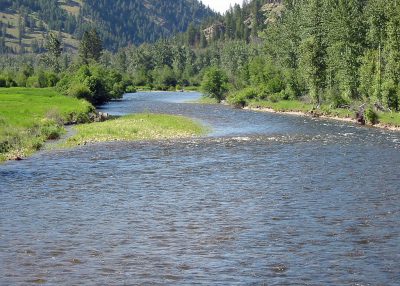
Lower Rock Creek in Montana. The last few miles of Rock Creek have the most difficult access on the river.
The hatch typically begins in mid-May to early June, frequently during the height of spring run-off. The hatch starts on the lower stretch of Rock Creek, and usually makes its way up the river at a pace of three to five miles a day. Nymph imitations are the fly of choice, particularly on the lower stretch of river, which is frequently turbid. Top water fly fishing can be done with fair success on the far upper stretch where the river tends to flow clear even during spring run-off.
To catch the larger trout during the Salmonfly hatch, an anglers’ goal is to present a stonefly nymph imitation that imitates stone fly nymphs crawling to shore. Use large nymphs (size 2 to 8), heavily weighted, on a sink tip line with strong tippets. Short leaders may also be used, and are suggested, when the river is turbid. While there are many nymph imitations that may be used, a Montana Stone, Bitch Creek and a Kaufmanns Stone all work well during the Salmonfly hatch.
The hatch can also be fished, with some success, on dry flies on the far upper reaches of the river where the river runs clear. Elk Hair Salmon Flies, Sofa Pillows and various large stimulator patterns can be used.
However, the Salmonfly hatch is primarily a nymph event. Top water fishing will catch fish, but the fish will not be as big nor is the angler likely to catch as many when compared to using large nymphs.
When fly fishing with nymphs during the Salmonfly hatch, one technique that works well is to cast the nymph upstream and then crawl it along the bottom towards the bank. Depending on river flows, this can be moderately easy to down right difficult, but will consistently catch the larger fish on Rock Creek. To do this successfully, the nymph needs to be “on the bottom,” so it is important to heavily weight nymph imitations, particularly in fast water.
An angler does not have to fish the hatch itself to be able to take full benefit of the Salmonfly hatch on Rock Creek. Fishing right before and after the hatch works as well, even sometimes better, than fishing during the hatch. As an added benefit, many of crowds are gone, reducing fishing pressure and allowing for a more relaxing day of fishing.
Other Summer and Fall Hatches on Rock Creek
Following the Salmonfly hatch, Rock Creek has a solid Golden Stone hatch, typically beginning in late June and lasting through July. Standard stonefly patterns, such as the Montana Stone and the Golden Stone, sized 4-8, work well.
During the height of summer, fishing top water with standard dry flies starts to work well. Fishing on top with Elk Hair Caddis and Adams flies may not pull in the largest fish, which are found in the deep pools. However, during the summer caddis and mayfly hatches, fishing on top is a wonderful way to pull in lots of fish in the 14-inch range.
Terrestrial fishing is also solid during the summer. While terrestrials are not as abundant as is found on rivers such as the Beaverhead, Bitterroot or the Big Hole, terrestrial imitations such as hoppers and ants can provide for solid fishing during July and August. A helpful hint: always bring plenty of hoppers for a Montana fly fishing trip in July or August.
Fall provides excellent fly fishing for brown trout on the lower stretch of Rock Creek. During the fall, brown trout move out of the Clark Fork in large numbers and head upstream. Streamers should be used when fishing for these browns, swimming them right along the bottom near the banks and through the holes. The fishing pressure is not nearly as high during the fall, so the fish tend to be somewhat less skittish and spooky. For the angler who likes to chase large brown trout with streamers, Rock Creek is an excellent destination during the fall.
Floating & Paddling Rock Creek
Rock Creek provides the floater with a wonderful float. However, if you plan on floating the river between July 1st and November 30th, plan on leaving your fishing gear in the truck. To prevent this small river from being over-run by guided float parties, no fishing from boats is allowed on the river during this time. You can bring your fishing gear, though. Just only fish when on shore.
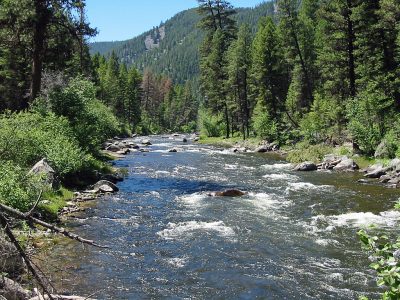
Rock Creek near the Dalles. The Dalles area is where the bulk of the whitewater is found.
This does not mean, however, that you can’t float the river. Indeed, since no guided fishing floats are allowed, a floater on Rock Creek will rarely see another boat on the river. Instead, what a floater is likely to encounter is numerous bank fisherman. Since the river is of only moderate width and not very deep, floaters are likely to encounter anglers right in the middle of the river. Because of the rivers quick flows, courtesy and alertness is required to avoid any unpleasant encounters between recreational floaters and shore anglers.
Floating on Rock Creek can begin at the confluence of the East and West forks. During higher water, floating can even begin further up on one of the forks.
Beginning from its origin at the confluence of the East Fork Rock Creek and West Fork Rock Creek, the river is easily floatable by beginners for the next thirty or so miles, all the way down the river to an access point known as Henrys Flat. When floating this section, all a beginner is likely to encounter are some small waves and lots of riffles.
Beginning just downstream from Henrys Flat, the whitewater portion of Rock Creek begins, and lasts for more than four miles, called the Dalles rapids. Numerous Class II and Class III rapids exist. The river moves extremely fast through this section and also becomes quite narrow. Large boulders in the middle of the river require constant vigilance to avoid.
Below the Dalles rapids, the river slows down as it flows onward for another twelve miles to the confluence with the Clark Fork.
Due to the rivers narrow width and often shallow depth, narrow, low-draft boats are best to floating Rock Creek. Very small inflatable rafts, inflatable kayaks and whitewater kayaks are the best boats for floats down Rock Creek.
Rock Creek : Selected River Miles
Listed below are selected river miles for the Rock Creek in Montana. Also remember that since the Rock Creek flows through National Forest lands for most of its length, countless unofficial access sites exist right off the road.
- Confluence of the West Fork and East Fork Rock Creek: 51
- Gillies Bridge FAS: 43.4
- Harry’s Flat: 17.5
- Dalles Campground: 14.5
- Norton Access Site: 12
- Valley of the Moon Campground: 3
- Clark Fork: 0
Related Articles on Big Sky Fishing.Com
- Photographs of Rock Creek
- Rock Creek Road Backcountry Drive
- Philipsburg Valley Scenic Loop
- Fishing the Clark Fork
- Philipsburg, Montana : Town info and photos