

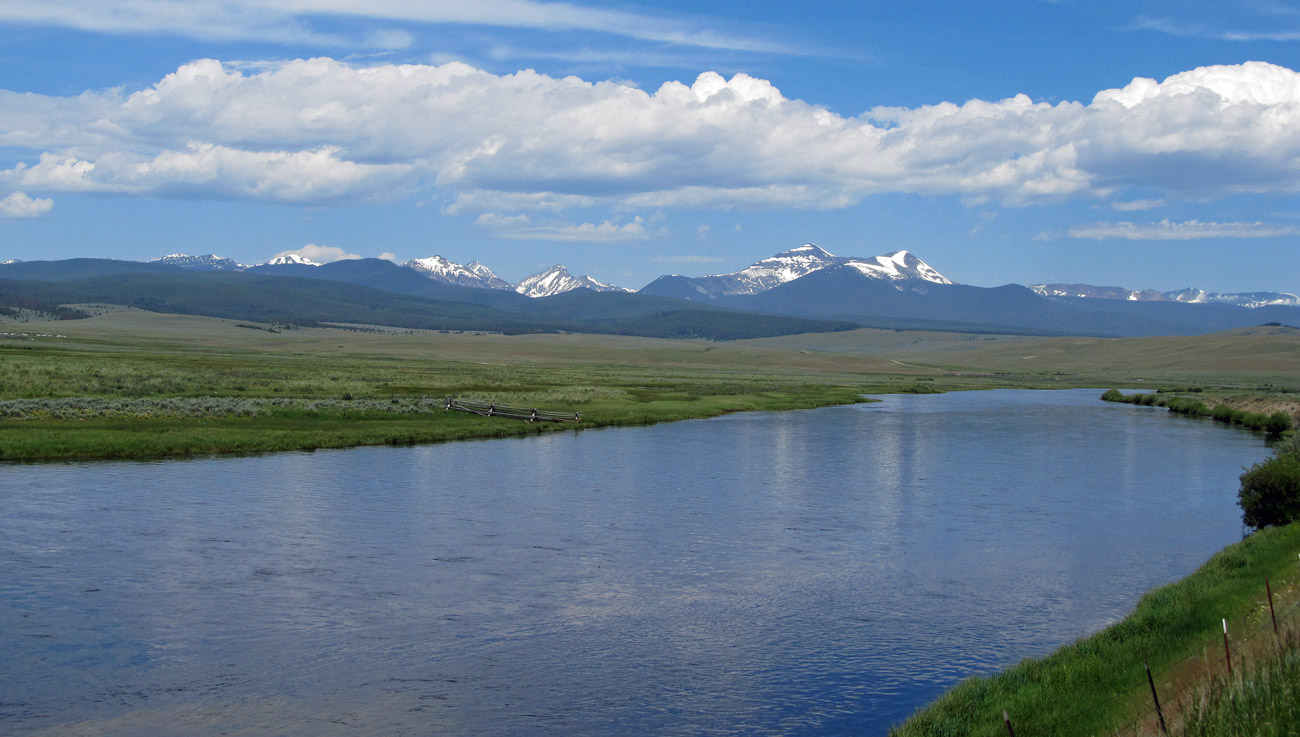
The Big Hole River is one of the prettiest rivers in Montana. Beginning at Skinner Lake, which is tucked away in the Beaverhead Mountains near the Idaho border, the Big Hole River flows for 155 miles in Montana before emptying into the Jefferson River at Twin Bridges.
Table of Contents:
- Big Hole River – Overview
- Fishing – Overview
- Fishing – Origin to Squaw Creek Fishing Access Site
- Fishing – Squaw Creek Fishing Access Site to Wise River
- Fishing – Wise River to Salmon Fly FAS
- Fishing – Salmon Fly FAS to Glen FAS
- Fishing – Glen FAS to the Jefferson River
- Floating & Paddling the Big Hole River
Related Article – Big Hole River Photographs
Big Hole River – Introduction & Overview
The countryside the Big Hole River passes through is gorgeous. At its origin, towering mountains surround the river. It soon leaves the mountains and enters the beautiful Big Hole River Valley, where it slowly makes its way towards Wisdom.
For those who have never been to the Big Hole River Valley, a trip is highly rewarding. This high elevation valley is surprisingly large and flat, even by Montana standards. Bordered by the Pioneer Mountains to the east and the Beaverhead Mountains to the west, the valley offers a picture postcard view of Montana.
The valley is quite isolated and sits at more than 6000 feet above sea level. Due to its elevation, the valley gets a fair amount of moisture by Montana standards and also gets quite chilly, even during the summer. The valley is primarily agricultural in nature, and produces more hay than anywhere else in Montana.
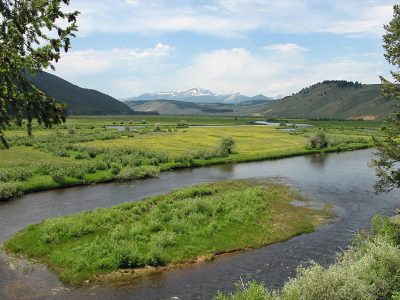
Big Hole River Downstream from Wisdom.
For those travelers seeking services, don’t expect to find many in the Big Hole River Valley. The largest town is Wisdom, which provides few services not directly related to fishing and ranching. Dillon, located sixty-five miles to the southeast, and Anaconda, fifty miles to the north, provide the best source for supplies and services. Butte also is quite close, relatively speaking, if you are fishing on the lower part of the river.
After leaving the mountains, the river flows due north through the massive Big Hole Valley, picking up velocity and volume from the numerous feeder creeks that spill from the high mountains. There are no official access sites to the river between Skinner Lake and Wisdom. However, numerous county roads cross the river, providing easy access for the wade angler and adequate access for floaters with small boats and inflatable rafts.
The river flows through the valley for more than sixty miles before it turns eastward where it enters a canyon. The Big Hole River picks up further velocity through this stretch and riffles become more frequent. A few small rapids also exist. The canyon is initially heavily forested on both sides of the river, but the forest lessens as the river travels further eastward and loses additional elevation. Access to the river in the canyon stretch is excellent. The Big Hole River is frequently bordered by federal land, and numerous official and unofficial access sites exist.
The canyon stretch of the Big Hole River continues for thirty miles, passing through the very small town of Wise River. The Big Hole then emerges from the canyon near the town of Divide, which is located along Interstate 15.
From Divide, the river turns south and flows through primarily arid country, with cottonwood trees frequently lining its banks, to the town of Glen. The best access to the Big Hole River in this stretch is from the designated access sites, as the river primarily flows through private land.
After twenty-five miles, the river makes one final turn and begins to flow to the northeast, through very arid terrain, towards the confluence with the Jefferson River at Twin Bridges. There are only four designated access sites between Glen and Twin Bridges. However, a number of unofficial access sites exist just off the road that follows the Big Hole River.
Beware Mosquitoes
A word of warning is needed to anyone visiting the upper Big Hole River for the first time. Mosquitoes are usually not a problem in most Montana valleys. However, the Big Hole River Valley is home to lots of these biting creatures.
All of the standing water, coupled with being one of the wetter and cooler areas in Montana, combines to produce vicious mosquitoes during a normal summer, particularly during June and July. Usually by August either an early season frost (the Big Hole River Valley is probably the coldest spot in Montana outside of West Yellowstone) or the dryness of late summer will have scaled back the mosquito populations to tolerable levels.
In other words, don’t forget to bring the mosquito repellent if you’ll be visiting the Big Hole River Valley.
If mosquitoes do chase you out of the valley, consider fleeing down to the Melrose/Glen area. There, due to the dryness of the area, mosquitoes are virtually non-existent—although you do have to watch out for rattlesnakes!
Fishing the Big Hole River – Overview
The Big Hole River is a study in contrasts. Few rivers in Montana flow through such a wide variety of geographical features. This beautiful river begins high in the mountains of the Bitterroot Range. It soon tumbles down the mountains and flows through the beautiful and massive Big Hole River Valley. This scenic valley is flanked by mountains on all sides and to many people defines what Montana is all about—big valleys, tall mountains and wide-open spaces.
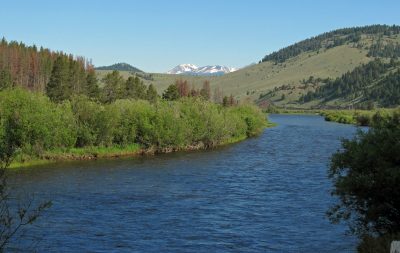
Big Hole River in Montana, downstream from Wisdom
The Big Hole River winds it way lazily through this valley before taking a sharp turn to the east and cutting through the mountains. Thick forests, rock cliffs and open agricultural fields provide a wonderful mix along the rivers shoreline and make for great fishing variety. Once the Big Hole River leaves the mountains, it spills out into a massive, sparsely populated arid valley where it continues on towards the confluence with the Beaverhead River near Twin Bridges.
The Big Hole River is nationally known as one of the premiere blue-ribbon trout waters in Montana and for good reason. The river is home to high numbers of wild and large rainbow and brown trout. Excellent brook trout fishing also exists on its upper reaches. Strict fishing regulations on the river help maintain both the fly fishing quality as well as limit the use of the river to some extent, keeping fishing pressure at tolerable levels most of the year.
Access to the Big Hole River for most of its length is excellent. A combination of numerous designated fishing access sites and informal road access sites provide an angler with many choices on where to access the river. T
The Big Hole River also flows through an area rich in wildlife. It is not at all uncommon to see mule deer, moose and elk all along the river. Throw all of this together with the beautiful countryside the Big Hole River flows through and you have all the makings of a wonderful fly fishing trip.
Big Hole River: Origin to Squaw Creek Fishing Access
This section of the Big Hole River is the most scenic stretch of the river, at least to me. Starting high in the mountains, the river, which is very narrow at this point, lazily twists and turns its way down into the stunning Big Hole River Valley. Once the river enters the valley, it continues to twist and turn with numerous braids and channels splitting the river up into a confusing network of small streams. The Big Hole River at this point is less of a river and more of a spring creek, since the river is very narrow and often closed in.
As the river winds its way north towards Wisdom, the Big Hole gradually picks up flows from feeder creeks and becomes both wider and deeper. Just north of Wisdom, the North Fork Big Hole River joins up, adding significant flows and width to the Big Hole.
The fly fishing on this stretch of the Big Hole River is primarily for brook trout, cutthroat trout, rainbow trout and the native grayling (all grayling must be released). The brook trout can become very large in this section, often exceeding sixteen inches. Most of the rainbow trout and cutthroat trout in this section run on the small side, averaging less than twelve inches.
Flies & Hatches
When fly fishing on this portion of the Big Hole River, standard dry flies and attractor dry flies work very well, although casting at times can be a challenge due to the rivers narrow width and “closed in” environment. Later in the summer, smaller grasshopper imitations also catch fish consistently. The best fishing for brook trout will be found on the upper half of this river section while the best rainbow trout fishing will be found downstream from Wisdom.
Access
Access to the Big Hole River in this section is good. Downstream from Skinner Lake the Big Hole River runs through National Forest lands for about seven miles. A forest road closely follows the river, allowing easy car access.
Once the Big Hole River reaches the valley floor, access becomes a little spottier. While many county road bridges cross the Big Hole River in the valley between Jackson and Wisdom, fences that rise right up to the bridge make getting into the river difficult. Anglers will often have to climb these fences to obtain access, never a lot of fun when wearing waders and wading shoes. Between Wisdom and Squaw Creek, access is much more difficult, since the river passes through private property without any road bridge crossings.
Fishing the Big Hole River : Squaw Creek Fishing Access Site to Wise River
This section of the Big Hole River in Montana runs for twenty-five miles and provides wonderful dry fly fishing for rainbow trout. Initially beginning in the north end of the Big Hole Valley, the river takes a sharp turn east thirteen miles downstream from Squaw Creek and begins cutting slicing its way through the mountains. The mountains in this section are heavily forested. The riverbanks are primarily a combination of forests, agricultural fields and open meadows.
The Big Hole River has flatter water on this section than is found further downstream (which has lots of riffles, pocket water and some small rapids), making it an ideal place for dry fly fishing. The lack of whitewater, combined with a slower current, narrower width and shallower depth, also make this section of the Big Hole River a perfect place for wade fishing. For the angler who lacks a fly fishing boat, this stretch of the Big Hole River is the perfect place to fish.
Flies & Hatches
Productive fishing on this section of the Big Hole River begins in March and April using large streamers thrown along the undercut banks, river obstructions and into the deeper holes. Large Wolly Buggers also work well to catch the larger rainbow trout; particularly when fished in the slower pockets of water found behind obstructions in the river, such as rocks and downed timber. Larger size flies (4-6) are recommended to avoid catching whitefish all day long (which are plentiful in the Big Hole River) instead of rainbow trout.
Beginning in May, water conditions permitting due to the variable nature of spring run-off, this section of the river becomes excellent for fly fishing using caddis fly imitations such as the X-Caddis, Elk Hair Caddis and the Tan Caddis, in smaller sizes of 14-18.
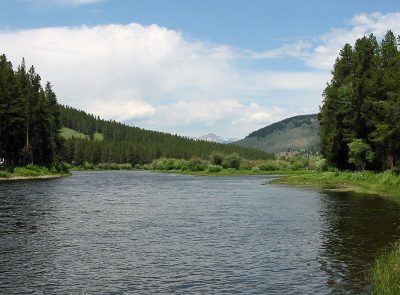
Big Hole River Downstream from Wisdom
Depending on weather and water conditions, a large caddis fly hatch occurs on the Big Hole River around Mothers Day, providing excellent and almost non-stop fishing when the hatch occurs. However, caddis fly imitations work equally well for a number of weeks before and after the hatch, and provide a wonderful opportunity for fly-fishing with dry flies. Best of all, as this hatch comes off in May, the vast majority of tourists haven’t arrived yet. As a result, fishing pressure during this hatch is low. Caddis fly hatches occur on the river through the middle of the summer and provide excellent fly fishing for dry fly anglers.
Like most rivers in Montana, the Big Hole turns brown and swollen during spring run-off. Should you arrive in May hoping to fly fish the caddis hatch, only to find the river blown out because of spring run-off, consider taking the short drive to the Beaverhead River, which runs clear all year long since its flows are controlled by Clark Canyon Dam. The Ruby River below Ruby Reservoir also provides an additional option.
June sees the primary event of the year on the Big Hole River—the Salmon Fly hatch. Usually by middle to late June, the river has cleared up so that an angler shouldn’t have to worry about arriving only to find a muddy, swollen river. Unfortunately, the crowds also arrive; so don’t expect to find solitude on the Big Hole during the month of June.
Popular nymphs for the Salmon Fly hatch include Bitch Creek Nymphs, the Kaufmann’s Stone and the Brooks Stone, in sizes 2-6. When nymph fishing during the Salmon Fly hatch, a popular method is to use a sink tip line, bouncing the nymphs along the bottom, particularly in the deeper holes and near obstructions. For the angler who hates fishing with nymph patterns, dry fly patterns for the Salmon Fly hatch such as the Sofa Pillow in sizes 12-16 also work well, although fishing the Salmon Fly hatch with dry flies will not catch as many larger trout as consistently when compared to using nymphs.
The month of July sees angler pressure fall somewhat as the Salmon Fly hatch winds down, although small hatches still periodically happen.
During July, and lasting for the rest of the summer until the first frost, the Big Hole River in this section (as well as for the remainder of its length), becomes, not surprisingly, a prime river for using grasshopper imitations. With the numerous fields of grass and agricultural crops lining the riverbank, the Big Hole River picks up lots of hoppers and other terrestrials on a warm summer day, particularly if its windy. Any good grasshopper imitation works well, with the best sizes being between 4-8. Fish the hopper imitations right along the shore, occasionally tossing the hoppers out into the middle of the river where there is good habitat such as behind rocks and over any deep holes.
Finally, beginning in September, dry fly anglers will have the opportunity for more top water fishing using standard dry flies such as the Parachute Adams, as solid mayfly hatches occur on the Big Hole during the fall.
Access
Access to the Big Hole River on this section is excellent. In addition to several designated fishing access sites, Montana Highway 43 closely parallels the river, providing for numerous unofficial access sights right off the road. The river also flows through a short stretch of BLM land on this section (the Upper Big Hole River SRMA), allowing for easy access. Camping is also not a problem. Numerous designated and unofficial sites exist along the river and in the nearby mountains.
Fishing the Big Hole River : Wise River to Salmon Fly FAS
This stretch is considered the prime fishing stretch on the Big Hole River. The largest trout, particularly the brown trout, are found on this section due to higher fertility in the Big Hole River and better habitat. The best brown trout numbers are found between Maiden Rock FAS and Salmon Fly FAS.
The character of the Big Hole River changes considerably from just upriver. For the first few miles below Wise River, the Big Hole resembles that found further upstream.
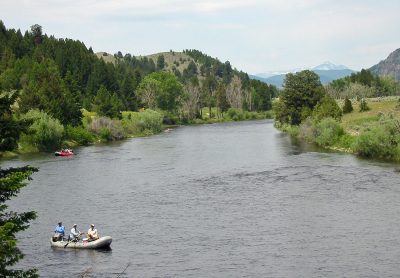
Fishing the Big Hole River near Wise River, Montana
Soon, though, the Big Hole River enters a canyon stretch, which it remains in to Divide FAS. The riverbanks change from forest and grass to rock and frequently small cliffs. An abandoned railroad bed follows the river on the north side, allowing for lots of access points for wade anglers, although it can be a difficult scramble down to the river due to all the rocks and steep slopes.
Montana Highway 43 also closely follows the river on the south side, with several designated fishing access sites and a number of road sites also providing additional access.
Beginning in Divide, and running down to the Salmon Fly FAS in Melrose, the Big Hole River changes character, again. The river flows through a delightful mix of country, almost as if the river is unsure of whether it wants to leave the mountains behind. It varies between running through small valleys on its eastern edge to slicing through a number of canyons, with the mountains sometimes heavily forested and other times almost completely barren of vegetation–particularly as the river nears Melrose.
Even the weather changes markedly on this section of the Big Hole River, since it can be cold and rainy in Wise River while warm and sunny just a few short river miles downstream in Melrose. In short, the Big Hole River offers an exceptionally wide variety of geography between Wise River and Melrose.
With such a wide variety in its geography and climate, the Big Hole River in this section has very diverse fly fishing conditions. A couple of short whitewater stretches and riffle sections that are found between Jerry Creek FAS and Divide FAS round out the variety.
The river between Wise River and Divide is of moderate width, although it is sometimes rather deep in spots. Wade anglers have excellent access along this stretch and are able to reach many of the prime fishing spots. Beginning at Divide fishing access site, however, the river widens. The additional width, combined with more restricted access, starts to limit wade anglers ability to reach the better fishing spots.
Flies & Hatches
Spring fishing on this stretch of the Big Hole River is similar to that found upstream. Streamers and Wolly Buggers thrown in the deep holes, around the undercut banks and behind the rocks all produce results. Wolly Buggers and other attractor dry flies in larger sizes work well for the top water fisherman, just as they do further upstream.
As is found further upstream, excellent dry fly fishing begins during May with the caddis fly hatch that occurs around Mothers Day. Assuming the Big Hole River isn’t blown out by high water, tremendous fishing for large rainbow trout and brown trout happen on this section. Caddis fly imitations work well on this section of the Big Hole, water conditions permitting, up through early July during a normal year.
June sees the Salmon Fly hatch, which is generally heavier on this section than is found further upstream. The hatch also happens earlier here than above Wise River due to warmer temperatures.
Beginning in July and lasting through September, like found further upstream, grasshopper imitations become the popular fly of choice, in sizes 6-10. On cloudy days, excellent fly fishing can be had the entire day. However, on warm, sunny days in July and August, particularly downstream from Divide FAS, the best fishing happens during the morning and later in the evening when the temperature is cooler.
And if you get tired of throwing hoppers around, caddis fly imitations such as the Elk Hair Caddis (sized 12-16) also work extremely well as the Big Hole River consistently has solid caddis hatches during the summer on this section. The best fly fishing using caddis fly imitations will once again be found earlier in the mornings and later in the evenings before sunset.
Additionally, if quality over quantity matters, consider tying on a large, weighted streamer on a sink tip line. Fish the streamers in the deep holes, around the many undercut banks or behind the rocks in the river. While few fish are caught this way, the largest fish on the Big Hole River often do not rise to the surface to take standard dry flies. A popular fly for this demanding duty is the Wolly Bugger, preferably in larger sizes.
Finally, when nothing seems to happen on top, nymph fishing using popular patterns such as the Hare’s Ear Nymph and the Prince Nymph (sizes 16-18) can work well for catching the rainbow trout.
Mayfly imitations, such as the Adams, work equally as well on this stretch of the Big Hole River during the fall as they do further upriver. Additionally, large streamers fished in the deep holes and along the undercut banks provide an excellent way to catch the large brown trout that are found between Maidenrock FAS and Salmon Fly FAS.
Access
Access to the Big Hole River between Divide and Salmon Fly is mixed. A number of designated fishing access sites exist, and the river does pass through a few short stretches of BLM lands that can provide additional access.
However, since no road follows the Big Hole River in this stretch, access for the wade angler is limited to the fishing access sites—which thus create a fair amount of fishing pressure around these sites. As a result, the best fly fishing is found either upstream or downstream from the designated fishing access sites.
Fishing the Big Hole River: Salmon Fly FAS to Glen FAS
This character of the Big Hole River in this section changes again, as the river begins its journey into the arid plain. As the temperatures of the water warm to higher levels, the fish on the stretch consist primarily of brown trout, both in healthy numbers and size.
Since this is primarily brown trout water, the fly fishing is more difficult on this section even though fishing pressure is significantly less than found further upstream. Good presentation is important in the slower water found on this section of the Big Hole River.
Flies & Hatches
The same hatches that occur further upstream also occur on this particular section of the Big Hole River. However, since larger brown trout rarely feed on top, dry fly fishing only has success during the heaviest of hatches. To catch the larger browns requires using large streamers such as Wolly Buggers on a sink tip line, fished in the holes, around undercut banks, behind rocks and around submerged vegetation.
During the middle of the summer, fly fishing can dry up completely during the middle of the day because of the heat and bright sunlight. As a result, anglers who plan to fish for the larger brown trout on this section should concentrate their efforts in the early morning hours and again later in the evenings.
Probably the best fishing on this section occurs during the fall. The cooler temperatures spur feeding activity and the fly fishing can be good all day long.
Access
Access to this portion of the Big Hole River is somewhat limited on this fourteen-mile stretch of water, since the Big Hole runs primarily through private property and is rarely followed by a road. As a result, a boat is best used when fly fishing this stretch of the river, although a wade angler who is willing to walk well away from the handful of fishing access sites will find success.
Fishing the Big Hole River : Glen FAS to the Jefferson River
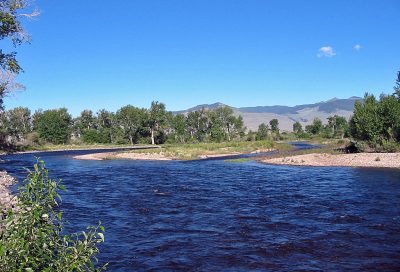
Lower Big Hole River, downstream from Glen Fishing Access Site.
This section of the Big Hole River runs for twenty-five miles through an arid valley. The Big Hole River travels for part of this journey well out in the valley, but soon makes it way to run along the southern edge of some small, arid mountains. The banks of the river range from grass to cottonwood trees to brush to rock.
What this section may lack in fly fishing quality and access, however, it makes up for in solitude. This is the most lightly fished and used section on the Big Hole River. Floaters and anglers on this section of river are likely to find solitude in a scenic setting.
Due to a somewhat slower current—especially later in the summer, the best fishing boats to use on this stretch of river are those boats that are easily paddled. Drift boats, inflatable kayaks, pontoon boats and inflatable canoes are all excellent boats for this section of river.
Flies & Hatches
This section is exclusively brown trout water and is best fished in the spring and again in the fall. Due to high water temperatures during the summer and irrigation withdrawals that lower the flows, quality fly fishing often dries up during the summer. Fall fishing, like found between Salmon Fly FAS and Glen FAS, revolves around using large streamers such as Wolly Buggers on sink-tip lines, fishing them in and around prime brown trout habitat.
Access
Access is dispersed downstream from Glen FAS. Only one designated fishing access site exists, although some road access is occasionally found along a fair condition dirt road (Burma Road), which loosely follows the Big Hole River from Glen to Twin Bridges.
Floating & Paddling the Big Hole River
A float or raft trip down the Big Hole River in Montana is a wonderful experience. Whether you wish to fish or to just sit back and take in the scenery, the Big Hole River provides wonderful floating, paddling and rafting opportunities.
Floating on the Big Hole River can begin near Jackson. Between Jackson and Fishtrap Access Site, the river is narrow. It meanders slowly through the Big Hole River Valley. No rapids are found, and you are quite likely to have the river to yourself, as float parties seldom use this section of the river.
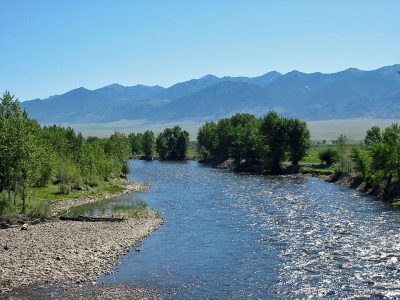
Lower Big Hole River in Montana, near the confluence with the Jefferson River
A canoe, inflatable canoe or inflatable kayak is highly recommended for this stretch since paddling is a necessity to get through frequent slow water pockets. The river is also often very narrow, which makes large rafts difficult to maneuver. The river does pick up volume and velocity on the lower stretch of this section further downstream with the additional flows provided by the North Fork Big Hole River.
From Fishtrap Access Site, the Big Hole River soon enters the canyon stretch. No significant rapids are encountered, but there are lots of riffle sections and a few stretches that have moderate sized waves just east of Wise River. This section is where the prime fly fishing begins and which also has the heaviest fishing and floating pressure.
The river leaves the canyon near Divide and enters arid country. A portage is frequently required around a diversion dam just upstream from Divide.
Downstream from Divide, the river continue with no major rapids and a decent current until the town of Glen, where the river turns northeast for its run to the Jefferson River in Twin Bridges. Most fishing parties exit at Glen since the fly fishing on the Big Hole River downstream tends to taper off, particularly in the summer.
Between Glen and Twin Bridges, the river runs moderately fast except during low water periods. Pressure on this stretch of the river is significantly less. The countryside is primarily arid, with willows and some cottonwood trees found along the banks. A diversion dam exists just below Pennington Bridge, which can either be portaged or be avoided by using the left channel.
Big Hole River : Selected River Miles
Listed below are selected river miles for the Big Hole River in Montana. You can get more detailed information about selected access sites at the Montana FWP site.
- Origin at Skinner Lake: 155
- Jackson: 139
- Wisdom: 116
- Confluence with North Fork Big Hole River: 102
- Fishtrap FAS: 81.4
- Sportsman Park Access Site: 80
- Dickey Bridge Access Site: 73
- Wise River: 65
- Jerry Creek Access Site: 62
- Dewey FAS: 57
- Powerhouse FAS: 54.2
- Maiden Rock FAS: 41.8
- Maiden Rock BLM Access Site: 41.2
- Salmon Fly FAS (Melrose): 38.3
- Kalsta Bridge FAS: 30.4
- Glen FAS: 24.9
- Notch Bottom Access Site: 17.9
- Pennington Bridge Access Site/Diversion Dam: 8.5
- High Road Access Site: 2.2
- Confluence with Jefferson River in Twin Bridges: 0
Related Articles on Big Sky Fishing.Com
- Photographs of the Big Hole River
- Big Hole Valley Scenic Drive
- Pioneer Mountains Scenic Byway
- Dillon, Montana – Town info and photos
- Fishing the Jefferson River
- Mt. Haggin Scenic Drive