
Fishing the Montana
Mountains
The Belt Mountains

|
Fishing the Montana
Mountains
|
|
 |
| You are Here > Home > Mountain Fishing > The Belt Mountains | Search Site |
The Mountains in Montana |
The Belt Mountains
|
 |
| Photo Use Guidelines |
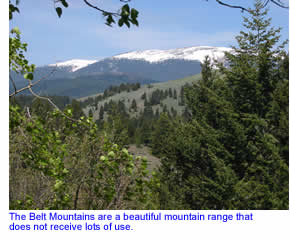
The Belt Mountains have two distinct ranges, the Big Belt Mountains and the Little Belt Mountains. For simplicity, both will be covered below since while they mountains are quite different from one another, both share one thing in common - limited backcountry fishing.
The Big Belt Mountains are located to the east of Helena, Montana, which is the state capital. They are difficult to miss as the rise abruptly up from the valley floor with a vertical rise of more than 5000 feet in some places. The Big Belt Mountains, lying as they do to the east of the continental divide, are more arid than the mountains found just to the west on the other side of the continental divide. Instead of having thick forests over much of their sides, the Big Belt Mountains have expansive areas of open meadows, grass and exposed rock. As they are a tall mountain range, many areas of the Big Belt Mountains are also over timberline.
Only one designated wilderness area, the Gates of the Mountains Wilderness that is found at the northern tip of the Big Belt Range, exists in the Big Belt Mountains. The rest of the mountain range is strictly forest service land. Numerous forest service roads of variable conditions enter and cross the Big Belt Mountains. The Big Belt Mountains are a popular place for locals to come out and explore the roads that traverse through these mountains.
The peaks of the Big Belt Mountains are quite rounded and even gentle, in stark contrast to some of the nearby mountain ranges such as the Bridger Range and the Crazy Mountains.
The only real lake fishing in the Big Belt Mountains is found near the ranges highest mountains, Mt. Baldy and Mt. Edith. Several small lakes are located to the north of Mt. Edith. A trail from the nearby Duck Creek Campground reaches these small, alpine lakes. The largest lake, Edith Lake, holds decent populations of small cutthroat trout.
 |
| Photo Use Guidelines |
Use of the Big Belt Mountains is relatively light. The lack of any protected wild lands, combined with the lack of alpine lakes and other attractions, tends to keep most visitors from ever seeing the Big Belt Mountains. Most of the use of the Big Belt Mountains comes in the form of off-roading, exploring the mountains forest roads and mountain biking. Horse packing is also popular due to the open nature of the mountains.
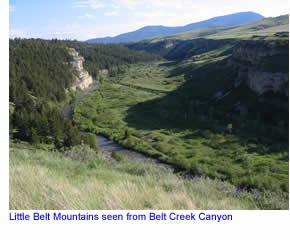
The Little Belt Mountains lie to the east of the Big Belt Mountains and to the south and east of Great Falls, Montana. Despite what their name suggests, these are a sizable mountain range. Smaller mountains are located on the western side of this range (to the west of Belt Creek), while much taller mountains dominate the skyline on the eastern side of the Little Belt Range.
The Little Belt Mountains are heavily forested in most areas, in contrast to the more open atmosphere found in the Big Belt Mountains. Use of the Little Belt Mountains is somewhat higher than the Big Belt Mountains. A popular ski area, Showdown Ski Area, lies at the pass on Highway 89. The mountains also draw lots of campers and day hikers from Great Falls, which is nearby.
Similar to the Big Belt Mountains, fishing in the Little Belt Mountain backcountry is less then special. A couple of small lakes are found just to the east of the highest peak in the Little Belt Mountains, Big Baldy Mountain.
Access to the Belt Mountains is excellent. Between the highways that cross the mountains and the forest roads that twist and turn throughout them, road access is excellent. An extensive trail network in both mountains exists, although some of the trails are used for more than hiking and horse packing. Numerous day hiking and week long expedition trips can be planned in both these mountain ranges.
Wildlife is abundant in the Belt Mountains, particularly the four-hoofed kind. Grizzly Bears are not found in the Belt Mountains, so for the person who dreads an encounter with these creatures, the Belt Mountains are a good place to go.
Camping is easy in the Belt Mountains. Many designated campgrounds exist and the open, relatively rolling countryside of both mountain ranges allows for ample informal camping possibilities.
Services are located reasonably close to most areas of the Belt Mountains. The Big Belt Mountains are located near Helena and the Little Belt Mountains are located within an easy drive of Great Falls.
| Montana Web Cams | Montana Information | Fly Fishing Gear | Fishing Boats | Internet Home Business | Site Map | About | Contact Us | Advertising Information | Privacy Policy |
.gif)