
Fly Line taper is one of those mysterious subjects that something few understand despite being quite simple. So, lets' begin with a very simple question...what the heck is a fly line taper?
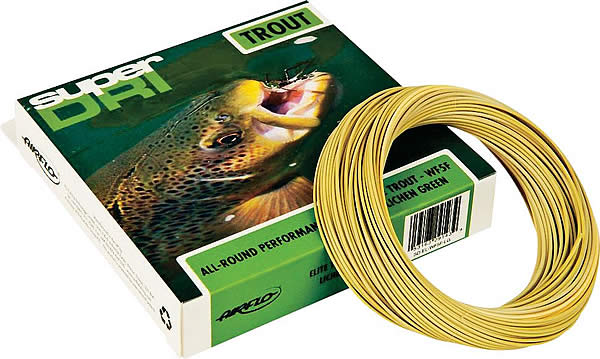 |
| Air Flo WF Fly Line for Trout, from Cabela's. |
A fly line taper is a small adjustment made by the manufacturer of the fly line to the fly line itself. This generally involves making parts of the line thicker in spots, heavier in spots, thinner in other spots, lighter in other spots. These adjustments to the fly line are done to give the angler better control of the line which, in theory, means improved casting.
Ultimately, whenever someone mentions "fly line taper" - think "adjustments to fly line." Because an adjustment to the fly line is all a fly line taper is.
So, why is fly line taper important? The taper of fly line plays an important role in how accurate an angler casts. This is rather important, obviously, in determining whether you catch any fish or get chased from the river empty-handed by laughing fish.
The Types of Fly Line Taper
Well, now that you know what a fly line taper, the next step is to understand the different types of fly line tapers available. There is quite a few of them, and more seem to be invented everyday, or at least every year. Yet, the general angler who chases trout, panfish and bass need only concern themselves with the following four types of fly line tapers.
WF - The Weight-Forward Taper
This is the "standard" taper for trout fishing. A Weight Forward Taper (abbreviation of WF on fly line boxes) is a fly line that has additional weight and thickness added to it in the first 10 yards of fly line. The remainder of the fly line is then of uniform thickness and weight.
The purpose of the weight-forward taper is to provide additional "heft" to the fly line. This additional "heft" allows the angler to make casting easier, especially on windy days. Since additional weight is on the front of the fly line, longer casts can also be made too. Finally, the extra weight on the end of the fly line helps larger flies turn over properly, thus landing on the water with proper presentation.
DT - The Double Taper
The Double Taper (abbreviation DT) is a fine fly line taper for trout fishing, unless you need to make long casts or it's windy. On a DT fly line the first fifteen feet of the fly line gradually widen in diameter. The next 60 feet of the fly line remains a constant weight and width. The final 15 feet of the fly line then gradually loses width and weight at exactly the same rate as was gained on the front of the fly line. One benefit of this type of taper is that it can be reversed as both ends of the fly line are equal.
So, why would a angler want to use double-taper fly line? Simple, the lighter front-end weight of the fly line allows for a "lighter touch" when casting and presenting the fly. However, the trade off is that it is more difficult to cast in windy conditions and shorter casts are more difficult to control.
In short, both the DT and WF tapers are perfect for trout fishing. Choose the taper, at the end of the day, that works well for the type of fishing you will do.
The Level Taper (L) and Shooting Taper (ST)
Two other fly tapers are worth mentioning, since anglers are bound to come across them sooner or later.
The Level Taper (L) fly line is the easiest of all fly line tapers to grasp simply because it has no taper. A level taper fly line has the exact same width and weight throughout it's entire length.
At first glance, this probably seems like it would be great for fly fishing. Well, the line does float very nicely due to its even weight and width. Additionally, level taper fly lines are the least expensive of all fly lines since nothing fancy goes into "adjusting" them.
Those two meager benefits, though, pale in comparison to the drawbacks. Level taper fly lines are significantly more difficult to cast and control than DT or WF taper fly lines. This is because there is no "heft" to the front of the fly line. Level taper fly lines also have a nasty habit of slapping into the water due to their even weight, and event that is not especially desirable when fly fishing for wary trout.
Overall, unless you have some compelling need, stay away from Level Taper fly lines. And beginners shouldn't use them at all.
The Shooting-Taper (ST) fly line is essentially a Weight-Forward fly line on steroids. The first 20 feet of the fly line is heavily weighted - far more so than a WF fly line. The remaining fly line is then of uniform width and weight, but is especially narrow.
The purpose of a ST fly line is simple - tournament casting - where anglers try to cast the fly as far as possible. Few anglers ever use this type of line while fly fishing since the hassles of the line outweigh its long casting benefits.
Unless you are an expert angler, there is no reason to use, or even own, a ST fly line. That is, unless you plan on tournament casting or just want to see how it works.
Well, wasn't that interesting? Everything you wanted to know about fly line tapers, and most likely some things you didn't.
So, whats' next. Well...now we move into the last and final stage of fly line selection - getting the Right Fly Line Density and Fly Line Color.
Next Page : Fly Line Density & Fly Line Color