
Once upon a time, buying winter boots was pretty simple. You didn't have a lot of choices, and what was available was frequently warm enough for an arctic expedition and weighed just slightly less than a heavy ball and chain. Hmmm...how times change.
Today, there are enough winter and snow boot varieties available to fill a sizable shoe store all by itself. Unfortunately, along with all these choices has come a bewildering array of insulation types, much of which is couched in rather obscure but important sounding terminology. So let's cut through the jargon, and get to what is important—what type of insulation you want in a boot and how much you need.
Since this page is rather lengthy, here are quick links to all sub-sections:
What Isn’t Insulation
There’s lots of terminology slung around today when shopping for winter boots. With all this terminology floating around, it is often difficult to determine precisely "what is what." In particular, I’ve found lots of confusion surrounds two words commonly found online when shopping for winter boots—Gore-Tex and Thermaplush.
Gore-Tex is not insulation. Many boots are "Gore-Tex" boots, which is a good thing. Unhelpfully, many Gore-Tex boots are labeled in ways that give the impression that the boot is insulated with Gore-Tex. Instead, Gore-Tex is a thin membrane of microscopic pores that surrounds part of the boot. The Gore-Tex’s function is to prevent external water from entering the boot while still allowing perspiration from the foot to escape. Gore-Tex, and other similar synthetic membranes such as Dri-Plus, accomplish this because water vapor from a foots perspiration is smaller in size than external water droplets. For this reason, Gore-Tex is a wonderful fabric for waterproofing not just footwear, but jackets, pants, hats, gloves and many other things (I’ve seen Gore-Tex computer backpacks). Just remember that Gore-Tex, all by itself, has virtually no insulation properties whatsoever.
Thermaplush, which is found in Baffin Boots and many other items, such as blankets, also is not insulation. Instead, Thermaplush is a comfort layer next to the foot. Basically, it is the most innermost layer of the boot, or the part which touches your foot when you wear the boot. Being very soft, almost velvety smooth, the purpose of Thermaplush is to simply provide comfort and a luxurious feel. But again, all by itself, Thermaplush provides little insulation value.
Now, with all that out of the way, let’s move on to the different types of winter boot insulation.
Thinsulate Insulation & Other Synthetic Insulations
There is really an amazing variety of insulation types available today in winter and snow boots. Yet, in the end, there are really only two major types that most people need to be aware of, Thinsulate (a synthetic insulation) and shearling.
Thinsulate™, made by 3M™, is by far the most popular winter/snow boot insulation type and for good reason. Thinsulate provides superb insulation in a very small package. Thinsulate is also extremely durable and won’t break down due to getting wet, frequent washings, and other rough treatment. Moreover, unlike goose down (which does indeed provide superior insulation all things being equal), Thinsulate is not bulky and, quite importantly, does not lose its insulating ability if it gets wet.
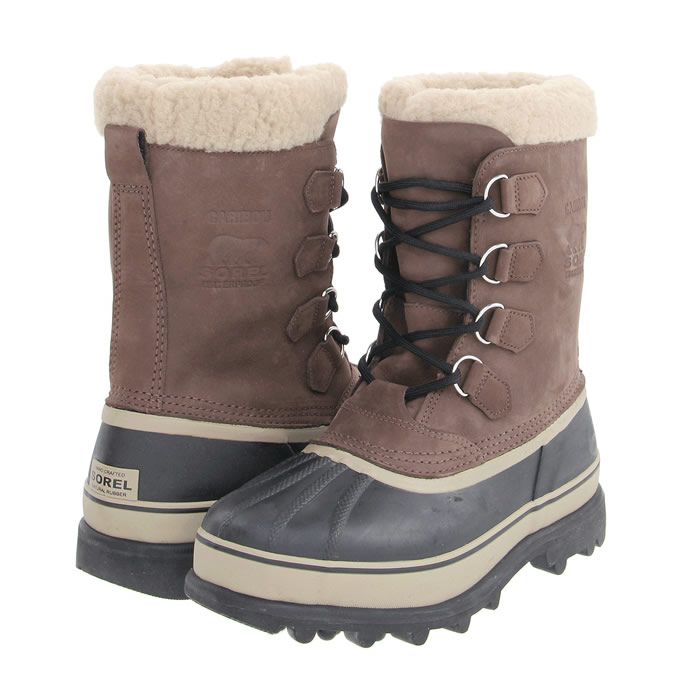 |
| Sorel Caribou Boot Uses Thinsulate Insulation |
Thinsulate, and other synthetic insulations, all work on the same principle—microfibers trap air molecules inside the insulation. By trapping the air molecules, the insulation greatly hinders the movement of colder air molecules outside the boot from making their way to the inside of the boot. And the reverse is also obviously true—the trapped air molecules in the insulation prevent the warm air molecules that surround your foot from escaping to the outside of the boot.
The reason Thinsulate is so popular is because it contains the finest and smallest fibers, thus allowing it to trap more air inside a smaller space. As such, Thinsulate is ideal insulation for footwear, gloves and hats—where bulky and heavy insulation isn’t practical.
Unfortunately, this is where the jargon begins, although happily the jargon is quite easy to understand. The insulation value of a snow/winter boot that contains Thinsulate is measured by the weight of the Thinsulate, in grams per square meter of insulation. Thus, you'll find boots with Thinsulate insulation that range from 100 gram insulation to 1000 gram insulation. The higher the number, the more Thinsulate is in the boot and, theoretically, the warmer the boot should be.
Read the section below on Understanding a Boot’s Temperature Rating for more on how to best determine how warm a boot you should get and what that temperature rating really means.
Thinsulate isn’t the only microfiber synthetic insulation on the market. Many other synthetic insulations exist, some of which are proprietary to certain brands of boots. Other synthetic insulations include Primaloft, Zylet, Heatseeker and Opti-Warm. The other synthetic insulations each have their benefits and drawbacks, but all work the same way that Thinsulate does—the microfibers trap air inside the boot, keeping the warmth in the boot and the cold outside of it.
Shearling Insulation
I love shearling, also known as fine fleece. I try to buy shearling whenever possible. It is soft, very snuggly and incredibly warm (if you get the high quality shearling, not the Wal-Mart version). The shearling found in Ugg Boots is second to none when it comes to softness and warmth.
Yet, for footwear, shearling has a few problems. It is plenty warm, that isn't the problem. Indeed, for most shearling boots (such as Ugg Boots), you don't even want to wear socks. The shearling works best with bare feet.
Instead, the problem with shearling in footwear is its durability. For general around town walking, going to the mall, commuting and other less-than-exotic uses, shearling insulation works just fine.
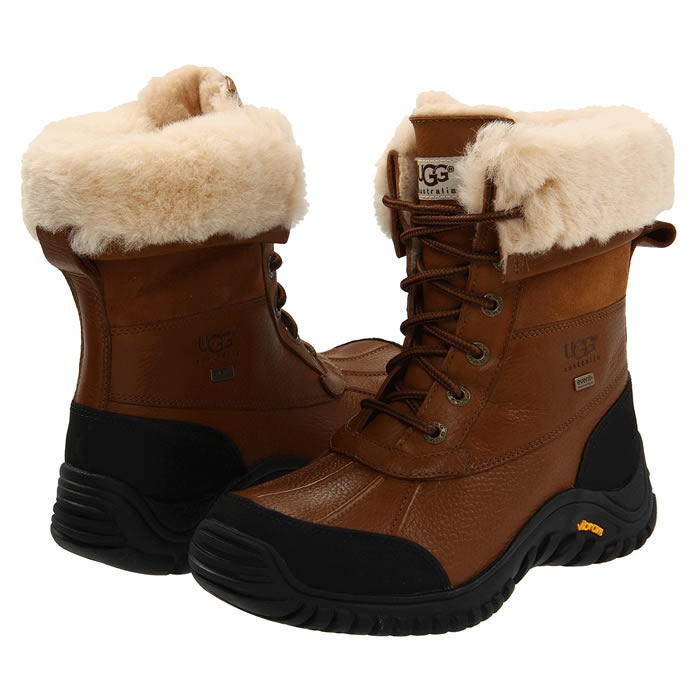 |
| Ugg Adirondack Boot Uses Shearling Insulation |
However, even the best shearling boots will slowly break down when taken out on long walks through deep snow, mud, and the other messy winter weather.
In short, shearling insulated boots are best used for what they have been designed for—a comfortable, stylish boot for general daily use. These boots are not meant for rugged outdoor excursions or for wearing when working outside for longer periods.
Recognizing this limitation, Ugg and several other manufacturers of shearling boots have created boots that successfully straddle the divide between an around-town shearling boot and a more rugged snow/winter boot. In particular, the Ugg Adirondack line of shearling boots is an effective and popular boot for people who love shearling insulation but want to use their boots for more demanding activities than just heading to the mall or to work.
Undestanding a Boot’s Temperature Rating
Sadly, there is no "set way" to rate a boot for temperature. While boot ratings are generally "in the ballpark" of their claimed rating, due to differing metabolism rates among people, how snug/loose the boot fits and what type of socks are worn, no winter boot can provide an exact rating for a particular person. My own general rule for winter boot ratings is to take their rating and then go up by about 10-15 degrees in temperature. Thus, a boot rated to 0 degrees I'll assume will only work well in temperatures above 10-15 degrees instead.
Additionally, and this is very important. A winter boot temperature ratings assumes you are wearing a quality winter type sock (not a flimsy cotton sock). The reason for this is simple. No matter how thick the insulation on a winter boot might be, if your foot is wet—which it will be when wearing a cotton sock—then your foot will still likely be cold.
Return to How to Keep Your Feet Warm in the Winter